
Yoga Therapy vs Yoga Classes: The Real Difference
People often ask me whether a good yoga class isn't enough — whether yoga therapy is just the same thing dressed up. It's a fair question, and the answer is genuinely useful, because once you see the difference clearly, choosing between them becomes easy.
The simplest way to see it
A yoga class is an asana class — a posture session. That's not a criticism; it's just what it is, and it's a wonderful thing.
Yoga therapy is the integrative daily routine: the nutrition, the mental practice running through your day, and an asana practice tailored specifically to you. It's the personalised approach to managing a chronic condition. And here's the part people miss — the two are designed to work together. Yoga therapy addresses the imbalance; once the system is balanced, you can return to a normal yoga class, because there's no longer an imbalance to attend to. At that point, the class becomes your maintenance.
That last piece is the priceless one: with TYLT there's a physiotherapist overseeing the work, so the management is monitored and flagged if something bigger shows up — and your progress is recorded and reviewed weekly, so the change is actually tracked rather than hoped for.
A class can't put you at the center
Live group sessions are genuinely useful. There's something good about a room full of people moving together — you flow with them, you're among others. But for someone with a chronic condition, that isn't always how it goes.
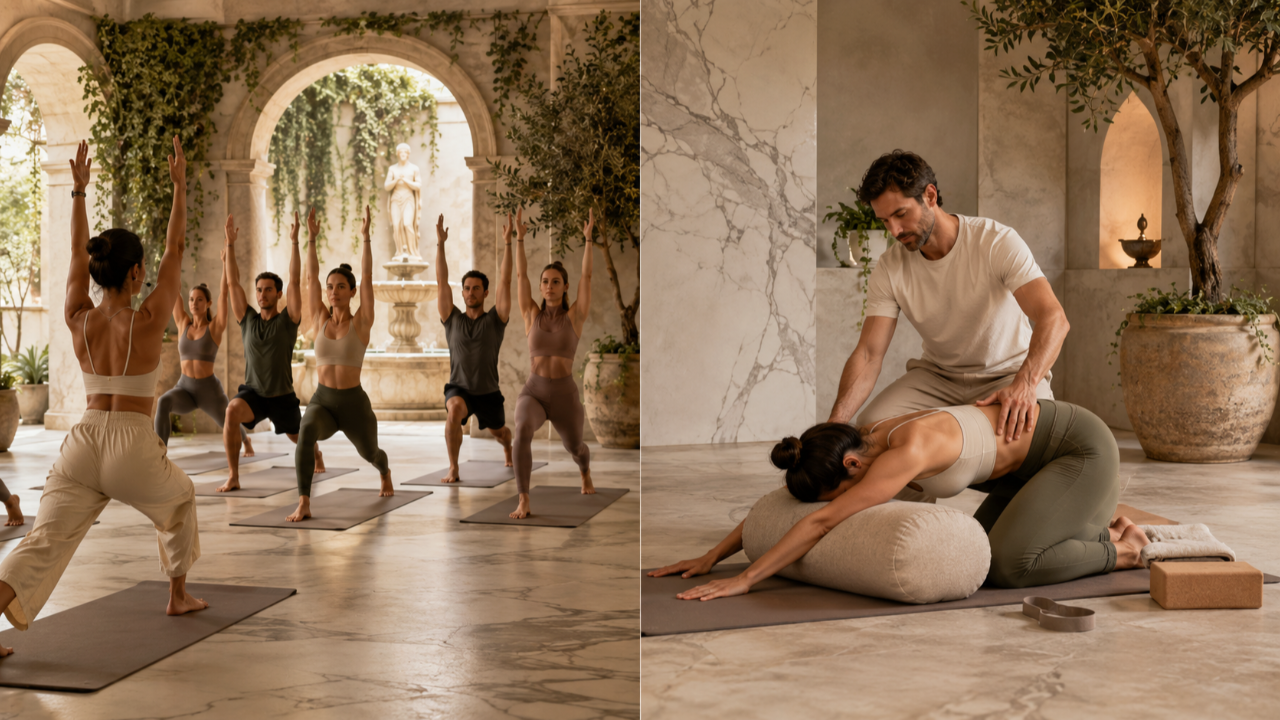
The difficulty is that some people have specific limitations from their condition that don't let them move freely as they please — there may be pain, trauma, breathlessness, sensitivities, or simply general difficulty performing the movements. In a class led for the whole room, those needs can't really be met. When you join a TYLT class, you get a personal touch and a one-on-one approach, making sure you do things correctly and at your own pace.
It's a yoga class that places you at the center — built around the goals and limitations you're actually working with.
So which one do you actually need?
I never want to push someone toward therapy who doesn't need it, so let me be straight about this.
A normal group class — outside TYLT — is a great choice for people who simply want to enhance their practice and don't have a serious health condition bringing limitations into the room. That's most people, and it's perfect for them.
The signal that it's time for TYLT is different: it's when you want to learn the yogic lifestyle and be monitored and kept accountable while your wellbeing progress is tracked. If that's what you're after, a class on its own won't get you there.
What the oversight actually does
This is where the two part ways most sharply. In a regular class, nobody is tracking you — you show up and you leave. With TYLT, the oversight creates the plan and the intensity for your specific ailment, exactly where it's needed, and folds that into your weekly progress so it's continually adjusted.
Why tracking changes everything
The reason that weekly tracking matters so much comes down to something simple and human.
Progress seen is progress believed.
When you can see the proof of your own progress, you feel more motivated, and you actually start to see a way out of a chronic condition. It supports the psychological side of healing and makes it far easier to follow a program — because you come to know what works and what doesn't for your specific condition, at that specific time. A class gives you none of that feedback loop.
A one-hour class was never going to be enough
I often meet people who'd been attending classes for a long time but weren't getting anywhere with their condition. The reason is almost always the same: a one-hour session never taught them the lifestyle and the pillars to continuously monitor and apply in their own life.
The practice was broken.
To integrate the yogic sciences is not a one-hour event. It's a continuous, integrating process. The moment you need to manage anything beyond the asana practice — and especially when there's a chronic condition involved — that's when yoga therapy is what's actually needed.
The risk of going it alone in a class
There's a real downside to managing a condition through unguided classes, and it's worth being honest about. If you biomechanically tune the body to do the wrong thing, and train the mind to act a certain way, you leave the whole homeostasis of hormones, breath and movement to chance — and you'll struggle to ever learn the skill of maintaining control.
The alternative is to educate yourself with a strong system and use it like armour, so you don't keep falling into difficult situations. Done correctly and naturally, the body makes the compensations it needs and adjusts accordingly, drawing on its own considerable ability to adapt and change for the better.
To be clear, this isn't about turning away from medical care. It's about building a skill that supports your body's natural capacity — managing your mind, body, digestion and daily habits toward the response you want — working alongside the guidance of your healthcare professionals, not instead of them.
They're not rivals — they're stages of one path
This is what I most want you to take away. A class and yoga therapy aren't competitors. Therapy is how you address and resolve the imbalance; the class is how you maintain things once you're well. Once you've succeeded in getting out from under a health condition, asana becomes your maintenance method — and you step back into ordinary practice.
And there's no pressure in any of it. When someone feels comfortable leaving, they leave. We don't bind anyone to any process — we simply offer something that can be used by people who need this approach.
If you take one thing from this: There is a method that can help you manage and maintain wellbeing. It's a skill — and it can be done by everyone.
How to start
If you've realised you want more than just a class, here's how it begins — and what to have ready.
- Sign up or take out a membership. Then schedule a call, or book a discovery call with one of our therapists to see if it's the right fit.
- Set up your space. Because you're guided online, you'll want enough room to be seen on camera and to see the screen clearly — a laptop or iPad with a camera is ideal, in a quiet, uninterrupted spot.
- Have simple props on hand. Depending on your condition, props like a chair, a belt or a block may be used.
- Follow the coaching course. From there it's a guided coaching course — daily reminders and notes are shared to keep you on track.
That's the move from class-goer to working with us: same love of the practice, but now with a system, oversight, and your progress tracked every step of the way.
One Free Week Access to Rome Retreat
Apply here if you still not sure and would like to see if TYLT is for you.